
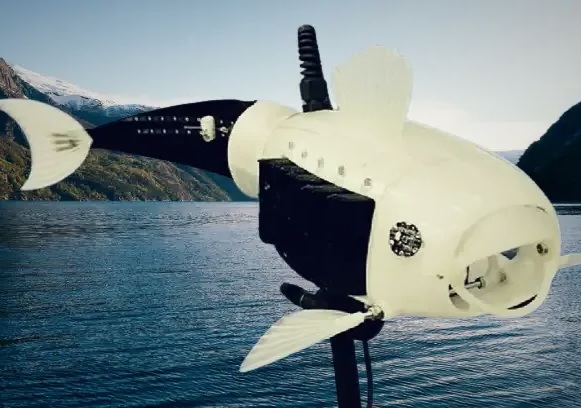
Robot Fish Fighting Plastic Pollution
At first glance, it looks just like an ordinary fish. It has a sleek body, moves smoothly through water, and swims with remarkable balance and precision. If you saw it gliding silently in a pond or tank, you would probably assume it was alive. But this fish is not a living creature at all. It is a machine — a robotic fish designed with a powerful purpose: to help clean water by removing harmful plastic pollution.
This innovative robotic fish was created by a student researcher at the University of Surrey in England. The project was developed as part of research into tackling one of the most serious and invisible environmental threats of modern times — microplastic pollution. The robot fish represents a creative blend of biology, engineering, and environmental science, showing how technology can imitate nature to solve human-made problems.
The Growing Threat of Microplastics
Plastic pollution has become a global crisis, but microplastics are particularly dangerous because they are hard to detect. Microplastics are extremely small plastic particles that come from broken-down plastic waste, synthetic clothing fibers, cosmetics, and industrial products. These particles often find their way into rivers, lakes, oceans, and even drinking water.
Health experts are increasingly worried about microplastics because they are usually invisible to the naked eye. When people drink water or eat food contaminated with microplastics, these particles can enter the human body without being noticed. Scientists fear that microplastics may cause long-term health problems, including inflammation, organ damage, and disruption of hormonal systems, although research is still ongoing.
A single microplastic particle can be as small as a fraction of a millimeter, but some can be as large as 0.2 inches or about 5 millimeters in diameter. Even at that size, it is not easy to detect quickly, especially in moving water. Traditional filtration systems are often expensive, energy-intensive, or ineffective at capturing such tiny particles. This is where the robotic fish comes in.
Meet “Gilbert” — The Robot Fish
The robotic fish is named Gilbert, and unlike ordinary water-cleaning machines, it works by copying the natural behavior of real fish. Gilbert can swim freely in water, maintaining stability and direction just like a living fish. Its movements are smooth and realistic, allowing it to operate efficiently in various water environments.
Gilbert’s main task is simple but revolutionary: to remove microplastics from water. When placed in water, the robot fish swims around and “swallows” water in the same way a real fish would while feeding. But instead of digesting food, Gilbert filters the water internally and traps microplastic particles.
Clean water is then released back into the environment, while the harmful plastic particles remain inside the robot’s filtering system. This process allows continuous cleaning without disturbing aquatic life or altering the natural flow of water.
How Does Gilbert Work?
The internal structure of Gilbert is inspired by real fish anatomy. Although it is a machine, its design closely resembles biological systems. Inside its body, Gilbert contains a special mechanical filtering unit, sometimes compared to a stomach or digestive system.
This internal filter — referred to in the research as a mechanical “Kanko” filter — plays a key role in separating microplastics from water. As water enters the robot, the filter captures plastic particles while allowing clean water to pass through. The microplastics are stored safely inside the robot until the filter is cleaned or replaced.
The advantage of this design is efficiency. Instead of relying on large external filtration plants, Gilbert can move directly through polluted water, targeting microplastics at the source. Because it mimics natural movement, it can operate quietly and with minimal disruption.
A Sustainable and Eco-Friendly Solution
One of the most impressive aspects of Gilbert is its potential for sustainability. Traditional water treatment systems often require large amounts of energy and infrastructure. In contrast, robotic fish like Gilbert could be deployed in lakes, reservoirs, or water treatment facilities with relatively low energy consumption.
Since the robot is designed to resemble a fish, it could potentially coexist with real aquatic life without causing harm. Its gentle swimming motion reduces the risk of damaging ecosystems, making it a promising tool for environmental protection.
Researchers believe that with further development, multiple robotic fish could work together as a swarm, cleaning large bodies of water more effectively. This could be especially useful in areas where plastic pollution is severe and access to advanced water treatment systems is limited.
Recognition and Achievement
Gilbert’s innovation has not gone unnoticed. The robotic fish recently participated in a robotics competition, where it competed against many other advanced machines. Thanks to its unique design, environmental purpose, and technical excellence, Gilbert outperformed the other robots and won the title of “Best Robot” at the event.
This recognition highlights the growing importance of environmentally focused technology. It also demonstrates how student-led research can lead to groundbreaking solutions with real-world impact.
Looking Ahead
While Gilbert is still a prototype, its success opens the door to exciting possibilities. With further refinement, robotic fish could become a common tool in the fight against plastic pollution. They could help protect drinking water, preserve aquatic ecosystems, and reduce the health risks associated with microplastics.
In a world struggling with pollution and environmental damage, Gilbert represents hope. It shows that by learning from nature and combining it with smart engineering, humans can develop creative solutions to some of the planet’s most pressing problems. What looks like a simple fish may, in fact, be a powerful guardian of our water.
Career opportunity বিকাশ লি:
Meghna Bearing Industries Career Opportunity
United co-operative society NGO Job
ইবনে সিনা ট্রাস্ট অভিজ্ঞতা ছাড়া চাকরি
কাজী ফার্মস গ্রুপে চাকরির সুযোগ
CARSA Foundation NGO Auditor Job
Robot Fish Fighting Plastic Pollution Robot Fish Fighting Plastic Pollution Robot Fish Fighting Plastic Pollution Robot Fish Fighting Plastic Pollution Robot Fish Fighting Plastic Pollution Robot Fish Fighting Plastic Pollution